How to Coach Low Block Defense Football Effectively?
I have coached youth teams for over a decade. The low block is the hardest system to teach. It is also the most misunderstood. Parents yell "press them" from the sideline. Players want to chase the ball. Nobody wants to sit deep and wait.
But the low block wins games. It frustrates elite teams. It protects leads. It gives underdogs a fighting chance. The trick is coaching it properly. You need discipline, structure, and repetition.
This guide breaks down the how to coach low block defense football process, based on real coaching sessions and modern tactical analysis.
What Is a Low Block?
A low block is an out-of-possession strategy. The defending team drops deep into its own defensive third. The goal is to protect the space close to goal where scoring chances are highest.
Read Also: Soccer Rondo Variations: Dynamic Drills for Faster Cognitive Development and Game Realism
The back line sits near the penalty spot. The midfield holds the edge of the box. The distances between units stay small. This compact shape denies the opposition time and space.
It is not the same as "parking the bus." Parking the bus is desperate and cynical. A well-coached low block is a deliberate plan. The team stays organized and waits for a trigger to counter-attack.
The Three Things Every Low Block Must Do
Before you teach drills, you must teach these principles.
Stay compact. Players must keep small distances between each other. If one player steps out, the whole block shifts. Gaps kill the system.
Protect the "V." Former Premier League manager Sean Dyche calls the space in front of goal "The V." Every defensive action protects this zone. Do not let attackers get a clear sight of goal.
Stay disciplined. Players must resist the urge to chase the ball. One player who dives in creates a hole. The opposition exploits that hole. Communication and patience matter more than aggression.
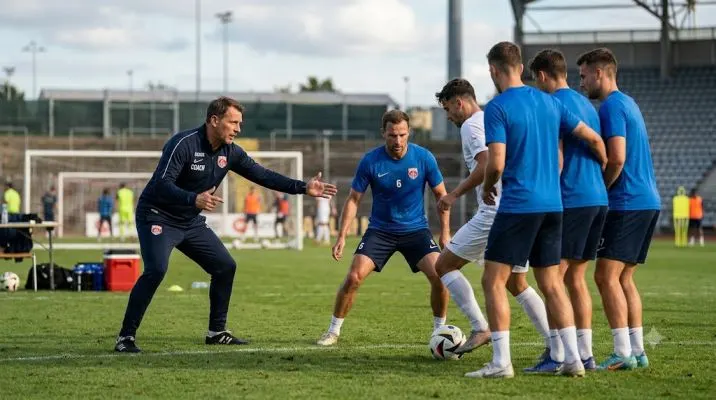
How to Coach the Defensive Shape?
Start with the back four and midfield four. That is the classic low block structure.
Step 1: Set the lines. Place your back four in line with the penalty spot. Place your midfield four six meters in front of them. The two lines should be close enough to cover each other.
You Must Also Like: Small Sided Games Soccer Drills for Youth | 25 Fun Ideas
Step 2: Teach the shuffle. When the ball moves to one side, the entire block shifts. The ball-side players press. The far-side players tuck inside. Nobody gets left behind. The block moves as one unit.
Step 3: Cover the half-spaces. The gaps between full-backs and center-backs are dangerous. A holding midfielder must drop into these gaps. This lets the center-backs stay central and protect the goal.
The Covering Drill That Teaches the Shuffle
Use this warm-up before every low block session. Set up a 20x20 meter area with four zones. Two teams of eight players each. Each team has four players in two zones.
The attacking team passes between zones. The defending team tries to intercept. Defenders cannot leave their zone to press. This forces them to shuffle together.
Coaching points: The player closest to the ball presses. The others tuck in behind. When the ball switches sides, the whole line moves. Players must stay patient. Do not dive in. Approach the ball carrier slowly. Block the forward pass.
The Crossing Drill That Teaches Center-Back Positioning
Most low block defending happens in the penalty area. Crosses are the biggest threat. Use this drill to teach center-backs how to defend them.
Set up a half-pitch. Two center-backs defend against two forwards and two wingers. The wingers cross from wide areas. The forwards attack the crosses. The center-backs must clear.
Coaching points: Center-backs should adopt a side-on body position. This lets them see both the ball and their mark. They must stay between the posts. Do not let them get dragged wide. Their job is to protect the goal, not chase runners.
The Formation Drill That Teaches Zonal Defending
Use a half-pitch. Eight defenders in two lines of four. Four attackers spread across the width. A server passes to one attacker. The defenders react and organize.
The defenders do not tackle the ball carrier. They just position themselves. They shuffle across. They cover passing lanes. The ball carrier protects the ball and returns it to the server.
Coaching points: The player who presses takes short, dynamic steps. Slow down on approach. The whole block shuffles together. Each defender follows the midfielder in front. The two lines stay connected.
The Opposite of Low Block: High Block and Mid Block
Coaches must understand the alternatives. The opposite of low block in football tactics is the high block or high press. A high block means the defensive unit positions around the halfway line and pushes into the opposition half. The goal is to win the ball back close to the opponent's goal.
A mid block sits between the halfway line and the defensive third. Most teams use a mid block as their default. They drop into a low block when the opposition has sustained possession.
The high press requires more energy. It is riskier. If the press breaks, there is space behind. The low block is safer. It protects the goal. It also cedes possession and territory.
Low Block vs. Park the Bus
The terms get used interchangeably. They are not the same.
"Park the bus" is a phrase Jose Mourinho popularized. It describes extreme, desperate defending. Ten players behind the ball. No attacking ambition. It is cynical and reactive.
A low block is proactive. The team defends deep, but it has a plan. It waits for a trigger to counter-attack. It stays organized. It frustrates the opponent into mistakes. Then it punishes them on the break.
The difference matters for coaching. You want your players to defend with purpose. Not with panic.
Common Coaching Mistakes
Mistake 1: Pressing too high. If your players chase the ball in midfield, they leave gaps behind. The low block only works if the block stays low. Teach patience.
Mistake 2: Defending as individuals. One player who dives in breaks the block. The system depends on collective movement. Nobody acts alone.
Mistake 3: Ignoring the counter-attack. A low block without a counter-attack is just survival. You must train transitions. When the ball is won, the team must break quickly.
Mistake 4: Poor communication. The block must shift together. That requires constant talking. Center-backs must organize the line. Midfielders must track runners. Silence kills the system.
How to Train Transitions from the Low Block?
The low block's best weapon is the counter-attack. Train this after every defensive session.
Set up a half-pitch. The defensive team wins the ball from a cross or clearance. Two forwards wait near the halfway line. The moment the ball is won, the forwards sprint wide. The midfielders look for the long pass.
Coaching points: The first pass after winning the ball must be forward. Do not let players pass backward. The forwards must make runs immediately. The team must transition from defense to attack in seconds.
The Final Thoughts
Coaching the how to coach low block defense football system is about discipline. Teach compactness. Teach patience. Teach collective movement.
Start with the covering drill. Add the crossing drill. Finish with the formation drill. Then train transitions. Repeat every week.
Your players will hate it at first. They will want to press and chase. Keep drilling. Keep reinforcing the principles. The low block wins games. It frustrates opponents. It protects leads.
The opposite of low block in football is the high press. Both are valid. Both require coaching. But the low block is the harder system to teach. It requires more discipline. It requires more patience. That is why so few teams do it well.